
Craniosynostosis Surgery Package
Assistance
Consultation
Services
Opinion
Care Coordination
What will your treatment cost?

See the cost breakdown by option, hospital and city →
| Surgery Name | Cost | Room | Hospitalization |
|---|---|---|---|
| Craniosynostosis Surgery Package | USD 8000- USD 15000 | Private | 7-8 days |
✓ Inclusion
- ✔Consultation with paediatric neurosurgeon and craniofacial plastic surgeon
- ✔Pre-operative blood tests, blood group and paediatric anaesthesia check
- ✔3D CT scan of skull (if not already done)
- ✔Surgeons' and paediatric anaesthetist's fees
- ✔Operation theatre charges and standard dissolvable plates/screws
- ✔Craniosynostosis surgery (suture release and skull reshaping)
- ✔Paediatric ICU care (1–2 days)
- ✔Total 7–8 day hospital stay in a private room
- ✔Nursing care, feeding support and medicines during stay
- ✔One parent stay with the baby in the room
- ✔Free: airport pick-up & drop, visa invitation letter, interpreter & coordinator (Satyug Healthcare)
✗ Exclusion
- ✖Blood and blood products
- ✖Moulding helmet after endoscopic surgery
- ✖MRI, genetic tests and other special investigations
- ✖Extra ICU or hospital days beyond the package
- ✖Additional or staged operations
- ✖Medicines after discharge
- ✖Hotel stay, meals and local travel
- ✖Flights, visa fees and travel insurance
- ✖Treatment of complications or unrelated conditions
Know More About Procedure & Surgery
Craniosynostosis Surgery in India
Surgery to release prematurely fused skull joints and reshape a baby's head, giving the brain room to grow normally. Done by paediatric neurosurgeons and craniofacial plastic surgeons with paediatric ICU support at accredited Indian hospitals, at a fraction of Western cost.
📖 What is Craniosynostosis?
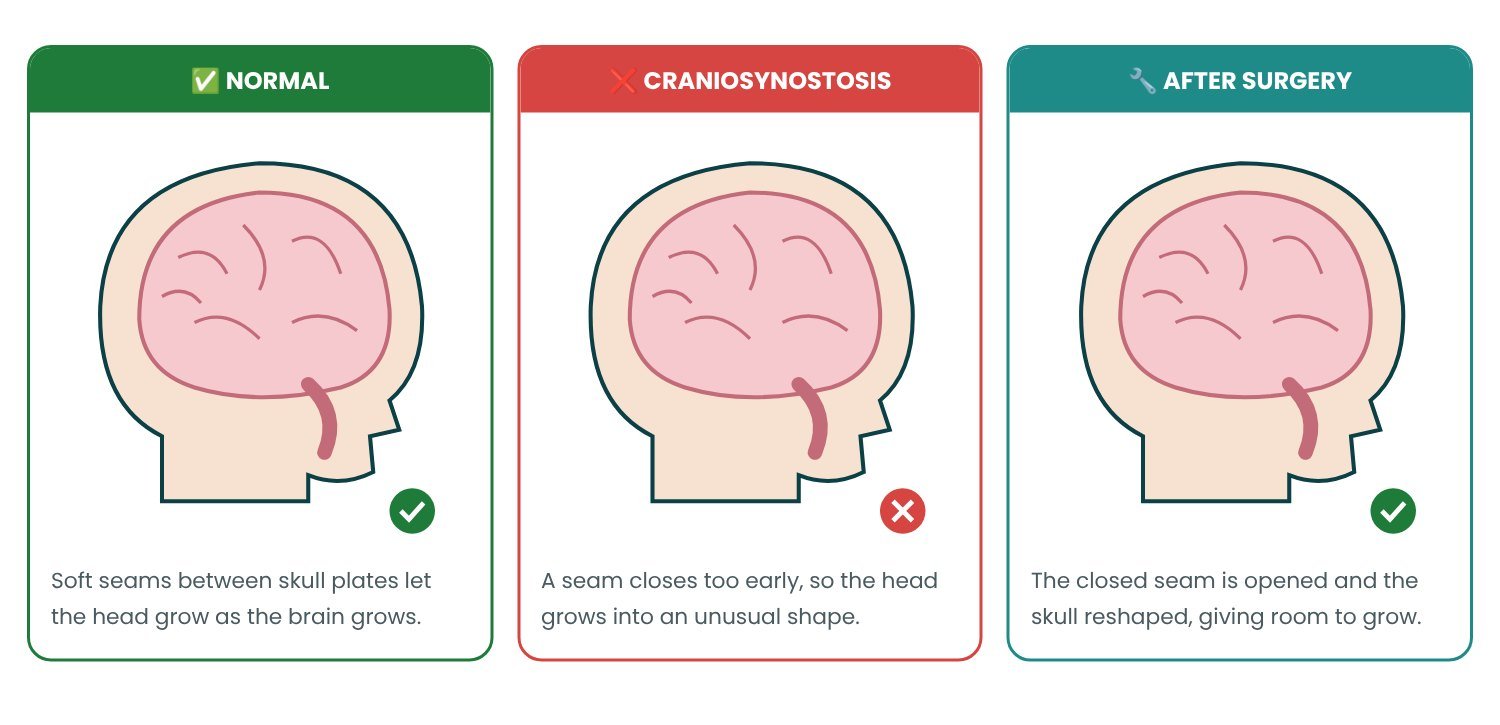
A baby's skull is made of several bony plates joined by flexible seams called sutures. These stay open in the first years of life so the brain can grow quickly. In craniosynostosis, one or more sutures close too early. The skull cannot grow in that direction, so it grows abnormally in other directions, giving an unusual head shape. It affects about 1 in 2,000–2,500 babies. When many sutures are involved, pressure inside the skull can rise and affect the brain, eyes and development.
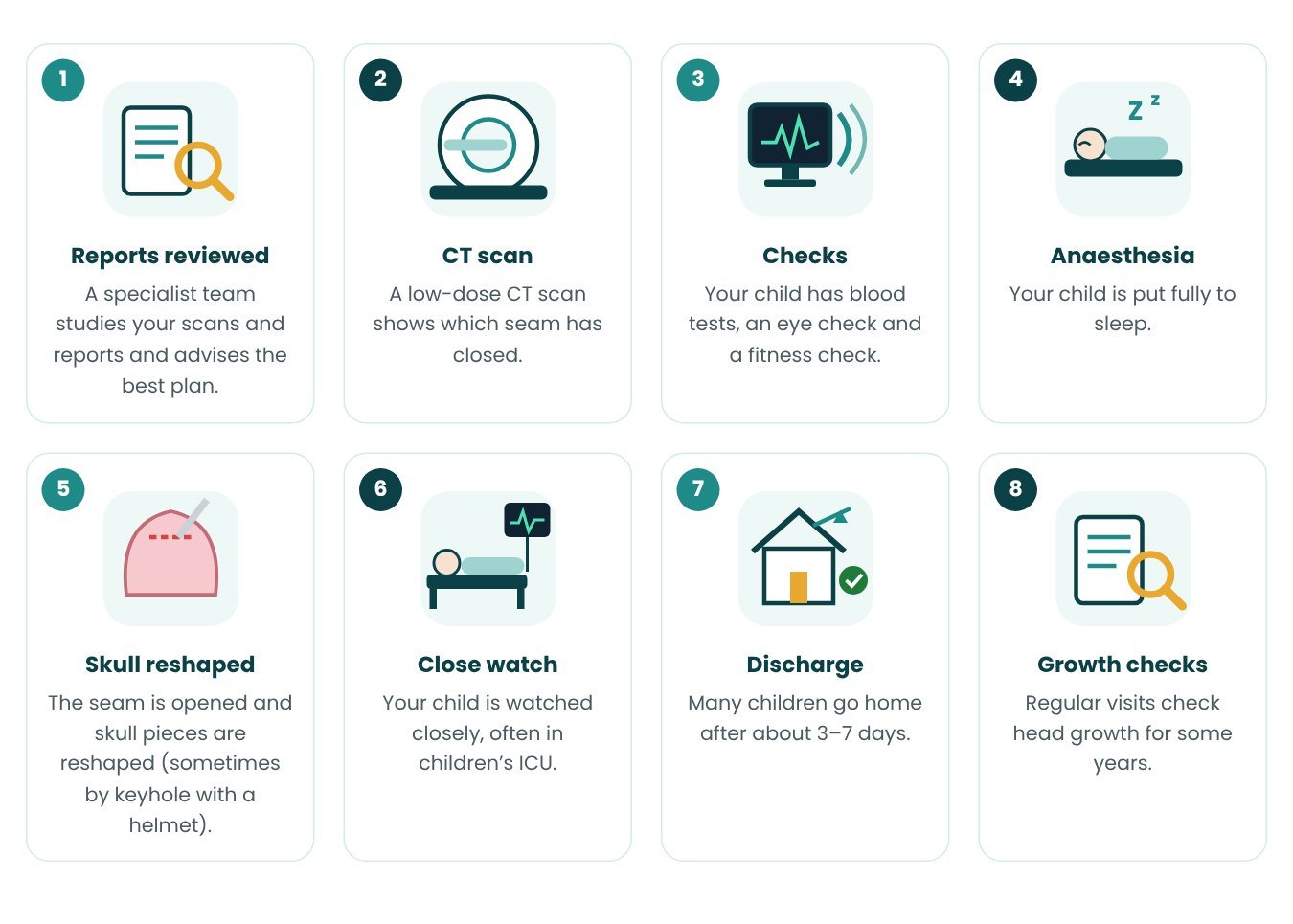
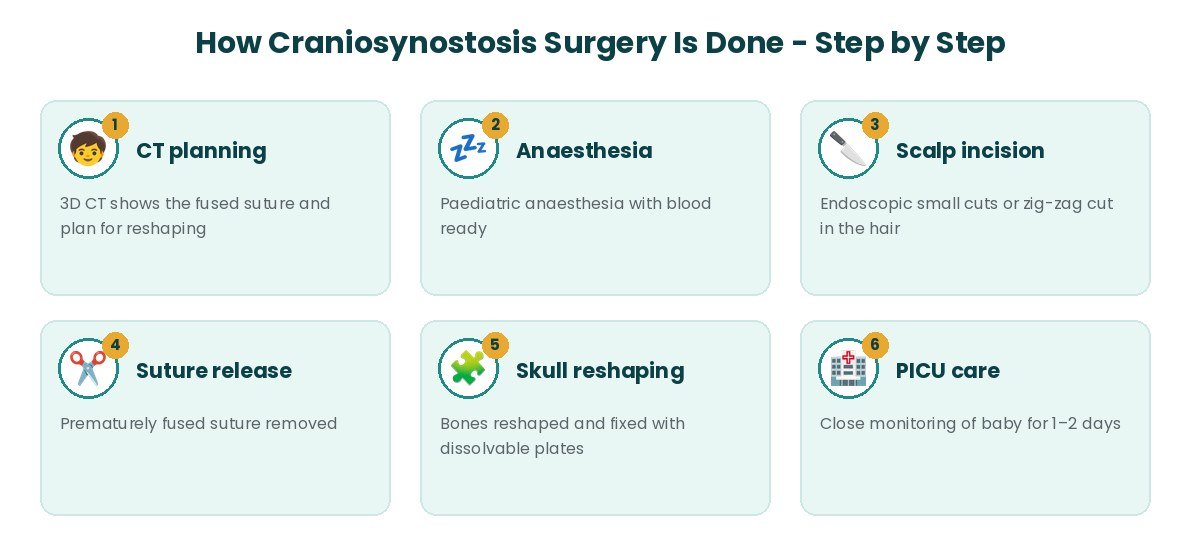
Craniosynostosis surgery opens the fused suture and reshapes the skull. In babies under about 3–6 months, endoscopic strip craniectomy through two small cuts can be done, followed by a moulding helmet. In older babies, cranial vault remodelling or fronto-orbital advancement is done through a zig-zag cut across the top of the head, in which the skull bones are removed, reshaped and fixed back with dissolvable plates. The goal is a normal head shape and enough space for the brain.
🖼️ Understand It in Pictures
Normal baby skull vs early-closed seam
👀 Symptoms in Pictures
🎬 The Treatment Journey in Pictures
📅 Recovery at a Glance
🩺 Types of Craniosynostosis Treated
⚠️ Signs That May Need Evaluation
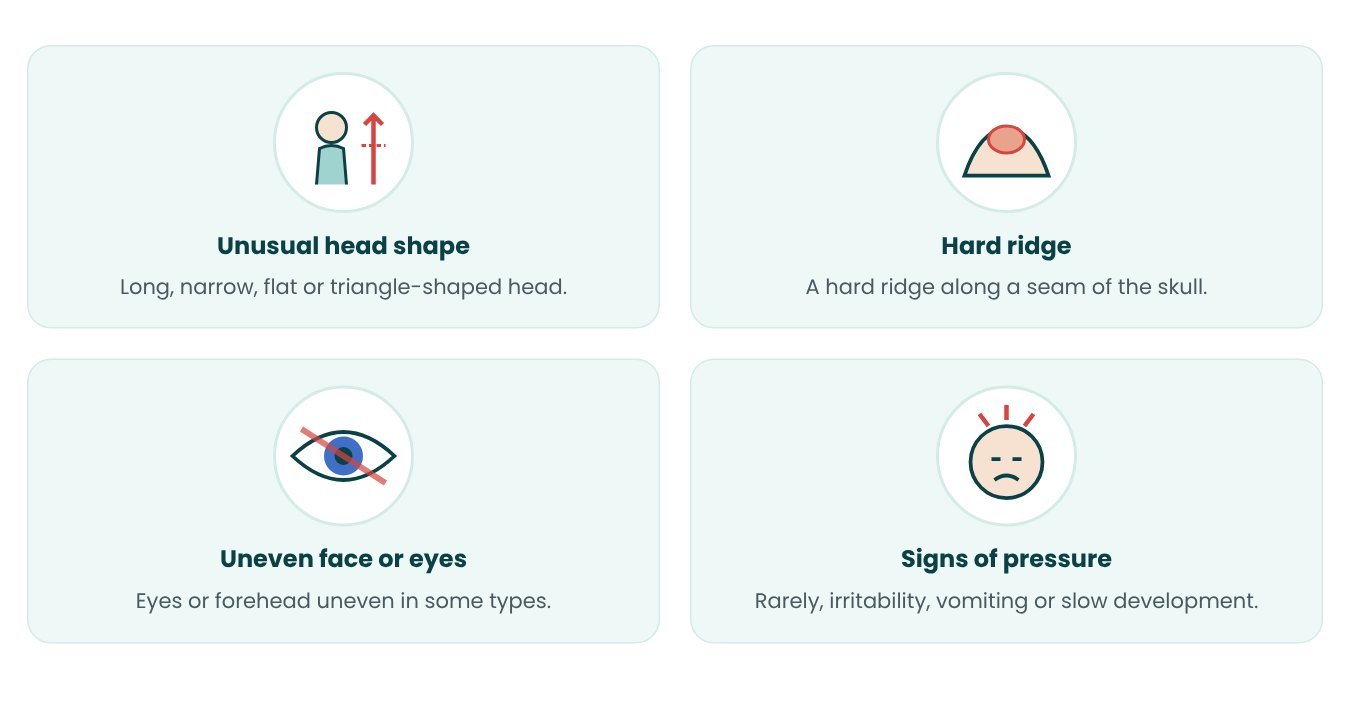
- ➤Unusual head shape from birth or early months
- ➤Hard ridge along a skull seam
- ➤Soft spot (fontanelle) closed early or absent
- ➤Head not growing normally
- ➤Uneven forehead or eyes
- ➤Bulging eyes (in syndromic cases)
- ➤Irritability, vomiting or headaches (raised pressure)
- ➤Developmental delay
🔬 Tests Before Treatment
| Test | Why it is done |
|---|---|
| Clinical examination by craniofacial team | Head shape, suture ridges, measurements and photos. |
| Low-dose 3D CT scan of the skull | Confirms which sutures are fused and helps plan surgery. |
| Eye examination (fundoscopy) | Checks for signs of raised pressure on the optic nerve. |
| MRI brain (selected cases) | Looks for brain or venous anomalies, especially in syndromic cases. |
| Genetic testing (selected cases) | For multi-suture or syndromic craniosynostosis. |
| Blood tests, blood group and cross-match | Babies often need a blood transfusion during open surgery. |
🏥 The Procedure — Step by Step
⚖️ Surgical Techniques
| Technique | What is done | Best for |
|---|---|---|
| Endoscopic strip craniectomy + helmet | Fused suture removed through 2 small cuts; helmet for 6–12 months | Babies under 3–6 months, single suture |
| Spring-assisted cranioplasty | Suture removed and springs placed to widen the skull | Sagittal synostosis at 3–6 months |
| Cranial vault remodelling | Open surgery to reshape the top and back of the skull | Babies over 6 months, sagittal or lambdoid |
| Fronto-orbital advancement | Forehead and brow reshaped and moved forward | Metopic and coronal synostosis, 9–12 months |
| Posterior vault distraction | Gradual expansion of the back of the skull | Syndromic or multi-suture cases |
📅 Your Day-by-Day Plan in India
| Day | What happens |
|---|---|
| Day 1 | Arrival in India ✈️, airport pick-up and hotel check-in |
| Day 2–3 | Consultation with paediatric neurosurgeon and craniofacial surgeon, 3D CT scan and blood tests |
| Day 4 | Admission and craniosynostosis surgery |
| Day 5–6 | Paediatric ICU monitoring |
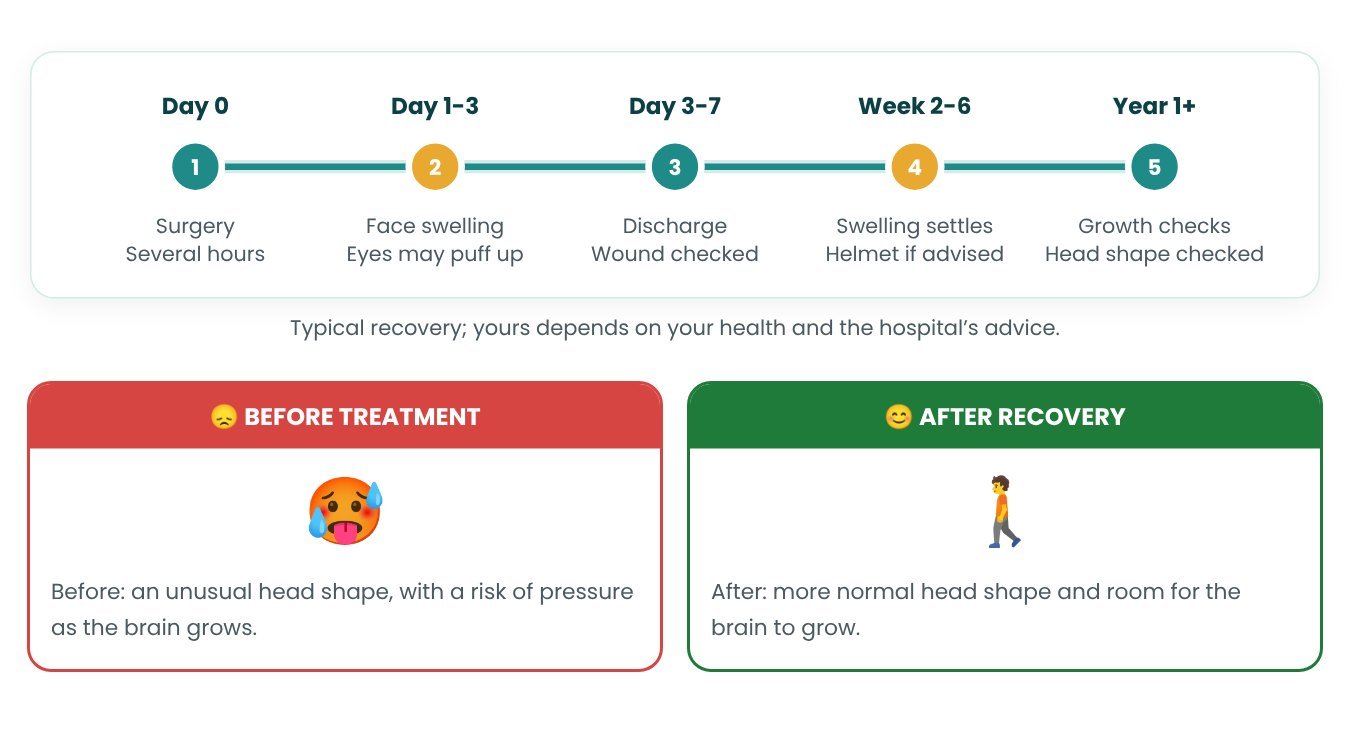
| Day 7–11 | Ward care, feeding and swelling settles (7–8 days in hospital in total) |
| Day 12–18 | Rest at hotel; wound checks; helmet fitting if endoscopic surgery |
| Day 19–21 | Final review – Fly home ✈️ |
🌱 Recovery After Treatment
🏆 Success Rate
| Outcome | Result |
|---|---|
| Good head shape (single suture) | About 85–95% |
| Re-operation needed | About 5–10% |
| Blood transfusion – open surgery | Common (60–90%) |
| Blood transfusion – endoscopic | About 10–25% |
| Serious complication rate | Under 1–2% |
Results are best with early diagnosis, the right technique for the baby's age and suture type, and a dedicated paediatric craniofacial team. Syndromic and multi-suture cases often need more than one operation as the child grows.
🩹 Risks & Possible Complications
Craniosynostosis surgery is major surgery in a small child, but serious problems are uncommon in expert centres.
- •Need for blood transfusion (common in open surgery)
- •Swelling of face and eyes for a few days (very common)
- •Infection (about 1–2%)
- •Leak of spinal fluid through a tear in the brain covering (dural tear, about 1–5%)
- •Irregularities or bony gaps in the skull
- •Need for repeat surgery (about 5–10%)
- •Very rarely, brain injury, seizures or death (under 0.5%)
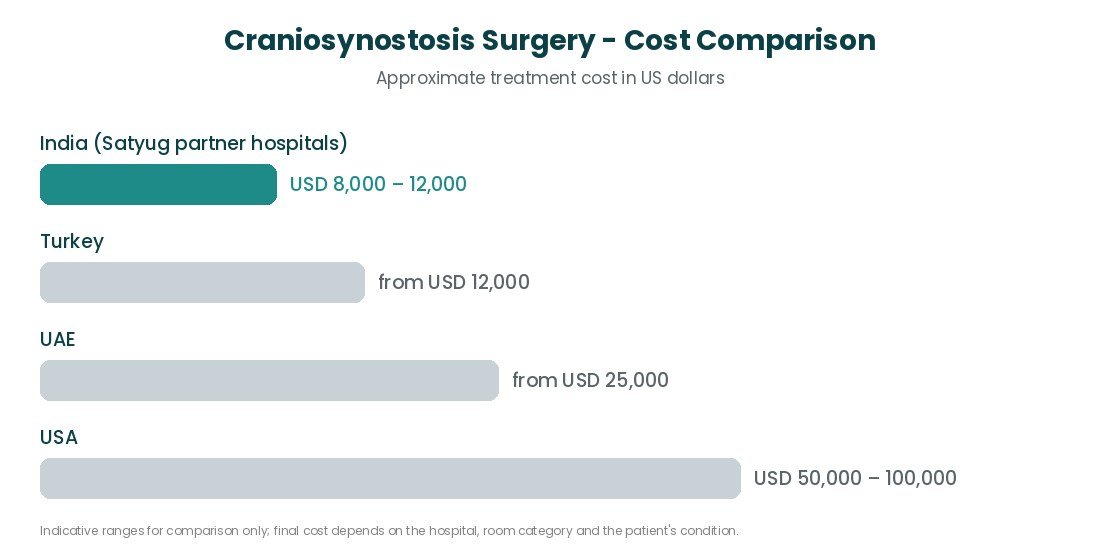
💰 Cost of Craniosynostosis Surgery in India
The cost of craniosynostosis surgery in India starts from about USD 8,000, including surgery by the paediatric neuro and craniofacial team, anaesthesia, paediatric ICU care and a 7–8 day stay in a private room. The final cost depends on the type of surgery, number of sutures, blood transfusions, implants and helmet therapy.
| Option / Hospital tier | Approx. cost (USD) | Hospital stay | Notes |
|---|---|---|---|
| Craniosynostosis surgery (this package) | 8,000 | 7–8 days | Private room; single suture open remodelling |
| Endoscopic strip craniectomy + helmet | 6,500 – 9,000 | 3–4 days | Babies under 6 months; helmet extra |
| Fronto-orbital advancement | 9,000 – 12,000 | 7–10 days | Metopic / coronal synostosis |
| Syndromic / multi-suture staged surgery | 12,000 – 18,000 | 10–14 days | May need several operations |
📋 What the Package Includes
- ✔Paediatric neurosurgeon and plastic surgeon fees
- ✔Paediatric anaesthesia
- ✔Operation theatre and implants (standard)
- ✔Paediatric ICU care
- ✔7–8 day stay in a private room
- ✔Nursing care and medicines
- ✔Post-operative scan as needed
- ✖Blood and blood products
- ✖Moulding helmet
- ✖Genetic testing
- ✖MRI if needed
- ✖Extra ICU or hospital days
- ✖Hotel stay and meals
- ✖Flights and visa fees
✈️ Your Medical Travel Process with Satyug Healthcare

| Step | Details |
|---|---|
| 1. Send reports | Clear photos of the baby's head from the front, top, sides and back, any skull X-ray or 3D CT scan (images and report), head circumference measurements, child's age and weight, birth history and any genetic or syndrome diagnosis. |
| 2. Free opinion & quotes | Within 48-72 hours you receive opinions and cost estimates from 3-5 leading hospitals to compare. |
| 3. Choose hospital & doctor | We help you compare doctors, success rates, room options and total budget. |
| 4. Medical visa | The hospital issues a Visa Invitation Letter (VIL) to the Indian Embassy. The patient and up to 2 attendants apply for an e-Medical / Medical Attendant visa. |
| 5. Travel planning | Flight guidance, wheelchair assistance, airport pick-up, hotel or guest house near the hospital. |
| 6. Treatment in India | Your coordinator and interpreter stay with you for admission, treatment, discharge and billing. |
| 7. Return & follow-up | Fit-to-fly letter, medicines, and online follow-up with your doctor after you return home. |
🎒 Travel Checklist
- 📌Valid passport (6+ months) for the patient and attendants, plus 10 passport-size photos each
- 📌Medical visa / e-visa and the hospital’s Visa Invitation Letter
- 📌All CT/X-ray reports and head photos, scans on CD / link and prescriptions
- 📌Yellow fever vaccination certificate (mandatory for travellers from African countries)
- 📌Polio vaccination certificate where applicable
- 📌Declare cash above USD 5,000 at the airport; hospitals accept wire transfer and cards
- 📌Foreigners staying longer than permitted must register with the FRRO — our team assists
⭐ Why Choose Satyug Healthcare?
❓ Frequently Asked Questions
➤ What is the cost of craniosynostosis surgery in India?
➤ What is the best age for surgery?
➤ How long will we stay in India?
➤ Is the surgery safe?
➤ Will my baby need a blood transfusion?
➤ Will there be a big scar?
➤ Is the baby in pain after surgery?
➤ Does it affect brain development?
➤ Will the head shape be normal?
➤ Is a helmet needed?
➤ What follow-up is needed?
➤ Can both parents travel?
➤ What should we send for a free opinion?
➤ Will an interpreter be available?
Medical disclaimer: This page is for general information and does not replace a consultation with a qualified specialist. Treatment plans and costs are confirmed only after the patient is examined. Sources: NCBI StatPearls: Craniosynostosis; American Association of Neurological Surgeons (AANS): Craniosynostosis; Great Ormond Street Hospital craniofacial information; Mayo Clinic: Craniosynostosis; Boston Children's Hospital; published outcome series from major craniofacial centres (J Neurosurg Pediatr, Plast Reconstr Surg). Infographics: Satyug Healthcare.
Craniosynostosis surgery in India from USD 8,000 – skull reshaping for babies by paediatric neurosurgeons & craniofacial surgeons, PICU care, 7–8 day stay.


TOP HOSPITALS
Special High-quality Hospitals




HAPPY PATIENTS
What Our Patients Are Saying














Our Gallery



Get a Free Quote
Tell us what you need and share your medical reports. Our medical team prepares your treatment plan and cost estimate.
- Free medical opinion on your reports
- Your quote within 24–48 hours
- Help with visa invitation letter, travel and airport pickup
- Coordinators available on WhatsApp
Prefer to talk? Call +91-8860606766 or WhatsApp us.
Thank you! Your request is received.
Reference . Our medical team will send your free quote within 24–48 hours by e-mail or WhatsApp.
Chat on WhatsApp now