Craniofacial Resection Package
Assistance
Consultation
Services
Opinion
Care Coordination
What will your treatment cost?

See the cost breakdown by option, hospital and city →
| Surgery Name | Cost | Room | Hospitalization |
|---|---|---|---|
| Craniofacial Resection Package | $15000 | Economy | Patient - 5 days in a ward and 2 days in ICU |
✓ Inclusion
- ✔Craniofacial resection by a combined neurosurgery and head-neck / skull base surgical team
- ✔General anaesthesia and anaesthetist fee
- ✔Operating theatre charges with neuronavigation and endoscopy equipment
- ✔2 days ICU stay
- ✔5 days ward stay in an economy room
- ✔Standard skull base reconstruction with local flap and grafts
- ✔Frozen section and final histopathology
- ✔Routine blood tests and post-operative CT/MRI during stay
- ✔Routine medicines and consumables during stay
- ✔Nursing care, physiotherapy and discharge summary
- ✔Free: airport pick-up & drop, visa invitation letter, interpreter & coordinator (Satyug Healthcare)
✗ Exclusion
- ✖Flight tickets and visa fees
- ✖Hotel stay before admission and after discharge
- ✖MRI, CT, PET-CT and biopsy before admission
- ✖Free flap reconstruction, orbital exenteration or other added procedures
- ✖Radiotherapy, proton therapy and chemotherapy
- ✖Extra ICU or hospital days and treatment of complications
- ✖Blood products, special implants and plates beyond standard
- ✖Medicines after discharge
- ✖Attendant food and personal expenses
Know More About Procedure & Surgery
Craniofacial Resection for Skull Base Tumours in India
Craniofacial resection removes tumours of the nose, sinuses and front of the skull base that reach towards the brain, in one complete block. Performed by combined neurosurgery and head-and-neck cancer teams at accredited Indian hospitals, at a fraction of Western cost.
📖 What is Craniofacial Resection?
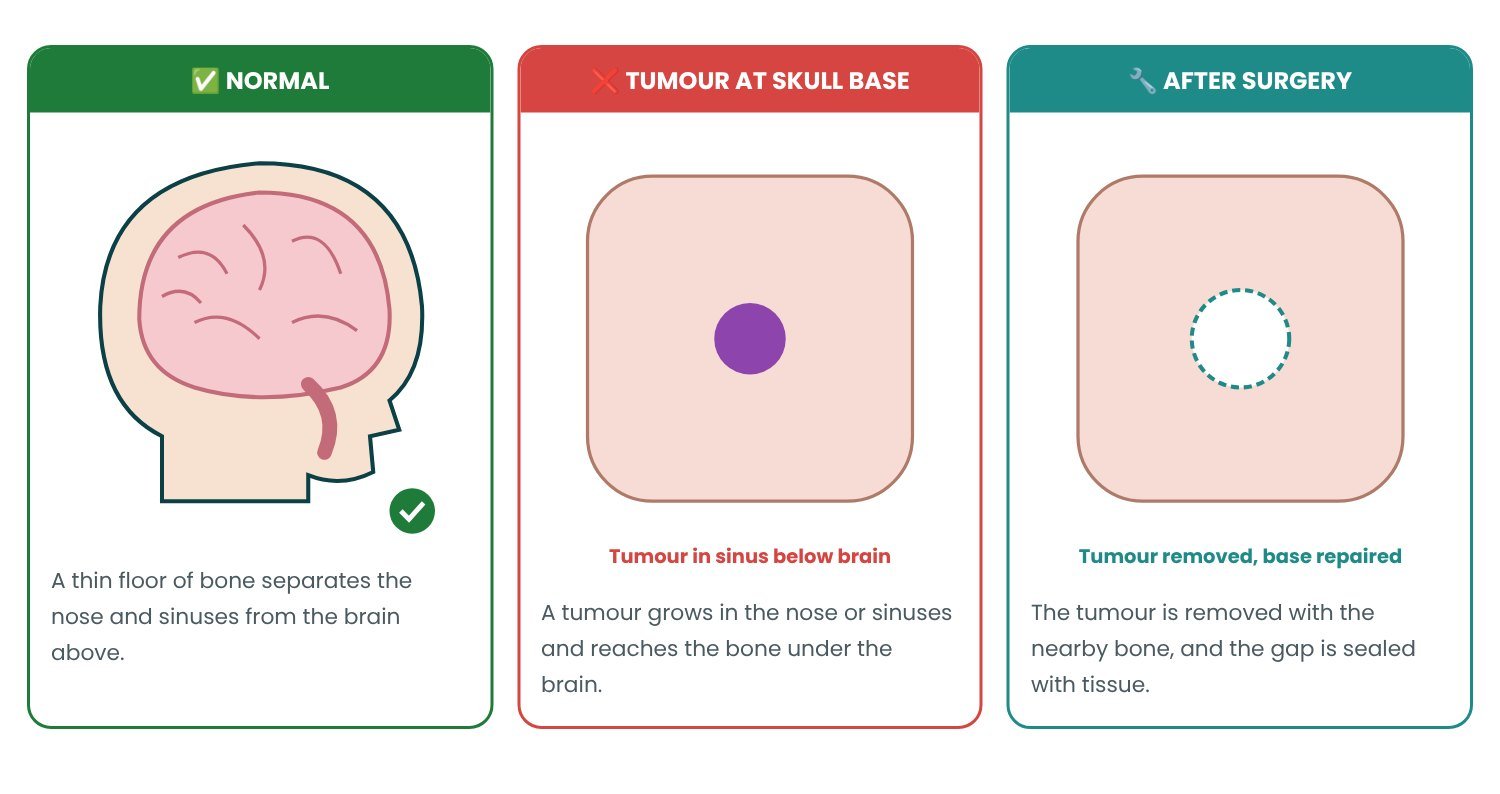
The anterior skull base is the thin floor of bone that separates the brain from the nose, sinuses and eye sockets. Tumours that start in the nasal cavity or sinuses (such as the ethmoid or frontal sinus) can grow up through this bone towards the brain. Tumours that start near the brain can also grow down into the nose. These tumours are rare and need specialised surgery.
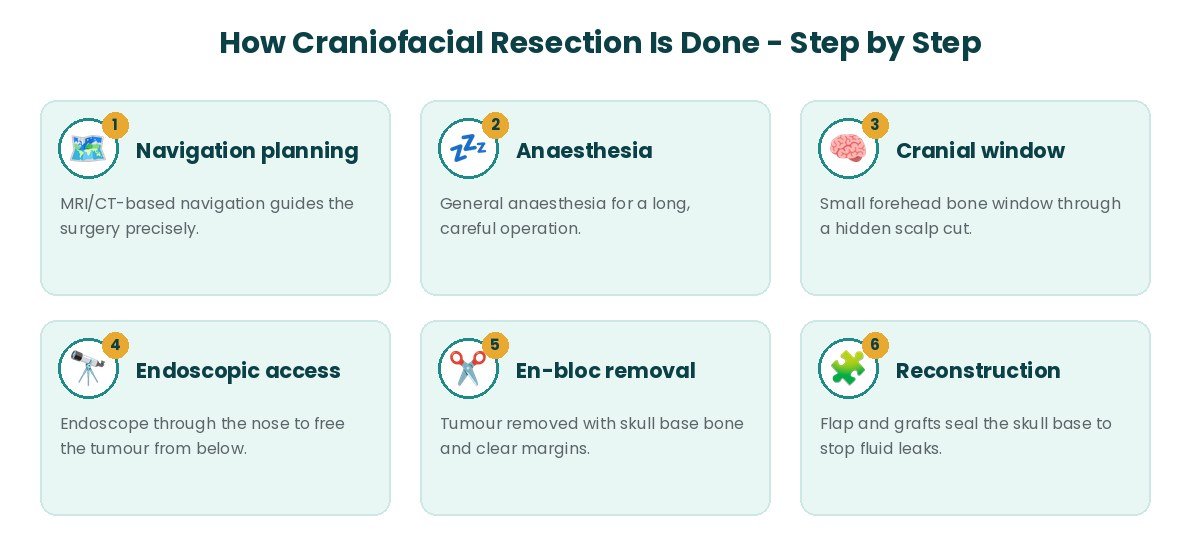
Craniofacial resection (CFR) is an operation that removes such a tumour together with the involved skull base bone and a margin of healthy tissue in one piece. A neurosurgeon works from above through an opening in the forehead bone (craniotomy), while an ENT / head-and-neck surgeon works from below through the nose or face. Today, many tumours can be removed by an endoscopic endonasal route through the nostrils, without facial cuts. The skull base is then rebuilt with a tissue flap to keep brain fluid sealed in.
🖼️ Understand It in Pictures
Normal skull base vs tumour reaching it
👀 Symptoms in Pictures

🎬 The Treatment Journey in Pictures
📅 Recovery at a Glance

Drawings: Satyug Healthcare (simplified, not to scale). Photos: Wikimedia Commons; author and licence under each photo.
🩺 Conditions Treated
⚠️ Symptoms That May Need Evaluation
- ➤Blocked nose on one side that does not improve
- ➤Repeated nosebleeds
- ➤Loss of smell
- ➤Swelling of the face, cheek or around the eye
- ➤Bulging eye or double vision
- ➤Persistent headache or facial pain
- ➤Watery eyes or reduced vision
- ➤Clear fluid leaking from the nose
🔬 Tests Before Treatment
| Test | Why it is done |
|---|---|
| MRI brain and sinuses with contrast | Shows the tumour's extent into the brain, eye socket and dura (brain covering). |
| CT scan of sinuses and skull base | Shows bone erosion and helps plan the surgical approach. |
| Biopsy (usually endoscopic) | Confirms tumour type, which decides the whole treatment plan. |
| PET-CT | Checks for spread to neck lymph nodes or distant organs. |
| Eye examination | Checks vision and eye movement before surgery. |
| Pre-anaesthesia tests | Blood tests, ECG, echo and chest X-ray for long anaesthesia fitness. |
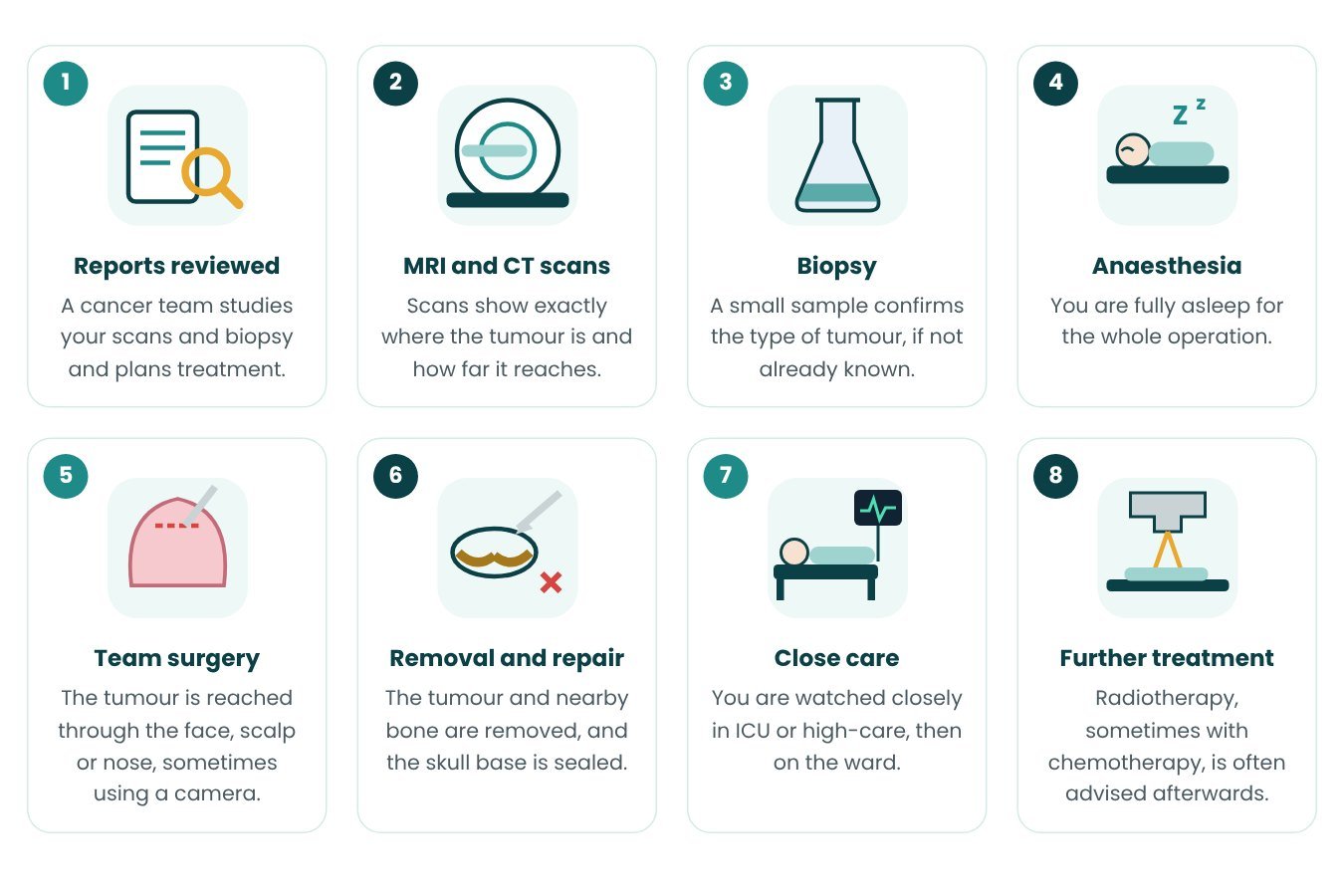
🏥 The Procedure — Step by Step
⚖️ Types & Techniques
| Technique | What is done | Best for |
|---|---|---|
| Open (traditional) craniofacial resection | Bicoronal craniotomy plus facial or endoscopic approach from below | Large tumours involving brain, frontal sinus, skin or eye socket |
| Endoscopic endonasal resection | Tumour removed entirely through the nostrils with an endoscope | Selected tumours limited to the midline skull base |
| Endoscope-assisted CFR | Small craniotomy combined with endoscopic work from below | Tumours with limited intracranial extension |
| CFR with orbital exenteration | Removal of the eye contents when the cancer invades the eye | Advanced tumours invading the orbit |
| CFR with free flap reconstruction | Tissue from the thigh or forearm used to rebuild large defects | Extensive face, palate or skin removal |
📅 Your Day-by-Day Plan in India
| Day | What happens |
|---|---|
| Day 1 | Arrive in India, airport pick-up, hotel check-in |
| Day 2–4 | Neurosurgery and head-neck consultations, MRI/CT/PET review, biopsy if needed, fitness tests |
| Day 5 | Tumour board decision and admission |
| Day 6 | Craniofacial resection surgery |
| Day 7–8 | ICU monitoring (2 days) |
| Day 9–12 | Ward care (5 days): walking, nasal care, removal of drains |
| Day 13 | Discharge (7-day hospital stay) |
| Day 14–25 | Hotel recovery, stitch removal, nasal cleaning, histopathology report and radiotherapy planning — Fly home ✈️ |
🌱 Recovery After Treatment
🏆 Success Rate
| Outcome | Result |
|---|---|
| 5-year survival – malignant tumours overall | About 55–70% |
| 5-year survival – olfactory neuroblastoma | About 70–80% |
| Complete (clear-margin) removal | About 70–85% of cases |
| CSF leak after surgery | About 3–10% |
| Overall complication rate | About 25–35% |
Results depend mainly on the tumour type and grade, how far it has spread into the brain or eye socket, whether clear margins are achieved, and the addition of radiotherapy. Benign tumours such as meningioma usually have excellent long-term results.
🩹 Risks & Possible Complications
Craniofacial resection is a major operation; serious risks are reduced in experienced skull base centres.
- •Loss of smell (expected when the smell nerves are removed)
- •Cerebrospinal fluid (CSF) leak from the nose (about 3–10%)
- •Wound infection or infection of the bone flap (about 5–10%)
- •Meningitis (about 1–3%)
- •Air inside the skull (pneumocephalus) or brain swelling
- •Double vision, watery eye or vision problems (uncommon)
- •Seizures, stroke or death (rare, about 1–4%)
💰 Cost of Craniofacial Resection in India
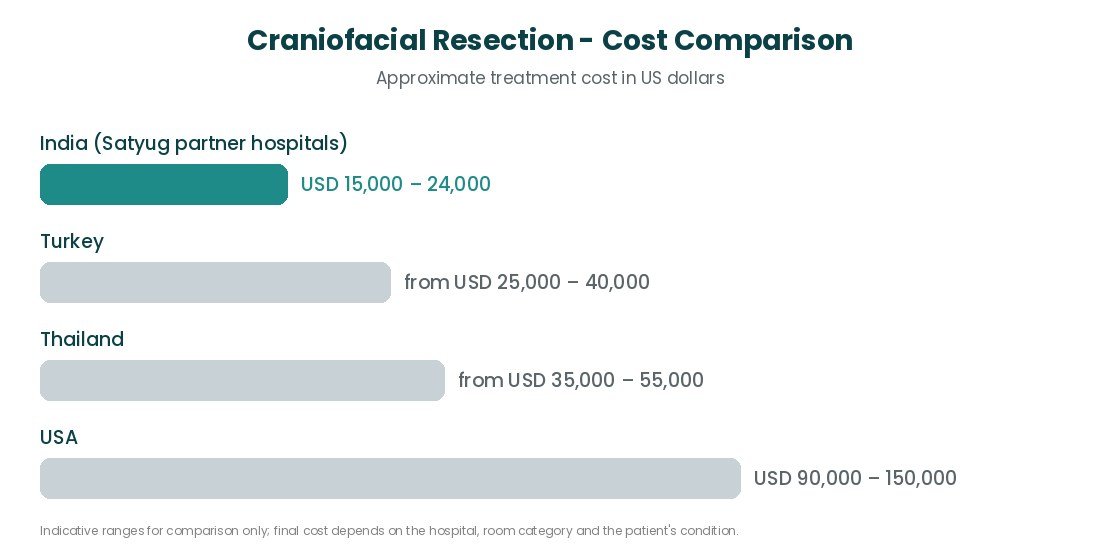
The cost of craniofacial resection in India starts from about USD 15,000. The package includes the combined surgical team fees, anaesthesia, operating theatre with navigation, a 7-day hospital stay (2 days in ICU and 5 days in an economy ward room), routine medicines and histopathology. Free flap reconstruction, eye removal, extra ICU days, radiotherapy and chemotherapy are charged separately.
| Option / Hospital tier | Approx. cost (USD) | Hospital stay | Notes |
|---|---|---|---|
| Craniofacial resection (this package) | 15,000 | 7 days (2 ICU + 5 ward), economy room | Combined neurosurgery + ENT team |
| Endoscopic endonasal skull base resection | 9,000 – 13,000 | 5–7 days | Selected smaller midline tumours |
| CFR with free flap or orbital exenteration | 18,000 – 24,000 | 10–14 days | Extensive tumours needing major reconstruction |
| Post-operative IMRT / proton radiotherapy | 4,500 – 7,000 (IMRT) | Outpatient | Proton therapy costs more and is available at select centres |
📋 What the Package Includes
- ✔Neurosurgeon & head-neck surgeon fees
- ✔Anaesthesia & neuronavigation
- ✔Operating theatre & consumables
- ✔2 days ICU + 5 days ward stay
- ✔Routine medicines & lab tests
- ✔Histopathology & frozen section
- ✔Nursing & physiotherapy
- ✔Airport pick-up & interpreter
- ✖Flights & visa fees
- ✖Hotel stay outside hospital
- ✖MRI, CT, PET-CT & biopsy before admission
- ✖Free flap or orbital surgery
- ✖Radiotherapy & chemotherapy
- ✖Extra ICU or hospital days
- ✖Blood products & special implants
- ✖Medicines after discharge
✈️ Your Medical Travel Process with Satyug Healthcare

| Step | Details |
|---|---|
| 1. Send reports | MRI brain and paranasal sinuses with contrast, CT scan of sinuses/skull base, biopsy (histopathology) report with slides or blocks if available, PET-CT if done, eye examination report, and details of any earlier surgery or radiotherapy. |
| 2. Free opinion & quotes | Within 48-72 hours you receive opinions and cost estimates from 3-5 leading hospitals to compare. |
| 3. Choose hospital & doctor | We help you compare doctors, success rates, room options and total budget. |
| 4. Medical visa | The hospital issues a Visa Invitation Letter (VIL) to the Indian Embassy. The patient and up to 2 attendants apply for an e-Medical / Medical Attendant visa. |
| 5. Travel planning | Flight guidance, wheelchair assistance, airport pick-up, hotel or guest house near the hospital. |
| 6. Treatment in India | Your coordinator and interpreter stay with you for admission, treatment, discharge and billing. |
| 7. Return & follow-up | Fit-to-fly letter, medicines, and online follow-up with your doctor after you return home. |
🎒 Travel Checklist
- 📌Valid passport (6+ months) for the patient and attendants, plus 10 passport-size photos each
- 📌Medical visa / e-visa and the hospital’s Visa Invitation Letter
- 📌All MRI / CT / PET scans on CD or link, biopsy reports, operation and radiotherapy summaries and prescriptions
- 📌Yellow fever vaccination certificate (mandatory for travellers from African countries)
- 📌Polio vaccination certificate where applicable
- 📌Declare cash above USD 5,000 at the airport; hospitals accept wire transfer and cards
- 📌Foreigners staying longer than permitted must register with the FRRO — our team assists
⭐ Why Choose Satyug Healthcare?
❓ Frequently Asked Questions
➤ What is the cost of craniofacial resection in India?
➤ How long does the surgery take?
➤ How long must I stay in India?
➤ Will there be scars on my face?
➤ Can it be done through the nose only?
➤ Will I lose my sense of smell?
➤ What is the success rate?
➤ Will I need radiotherapy after surgery?
Medical disclaimer: This page is for general information and does not replace a consultation with a qualified specialist. Treatment plans and costs are confirmed only after the patient is examined. Sources: NCBI StatPearls: Anterior Craniofacial Resection; Ganly I et al., Head Neck 2005 (international collaborative study on craniofacial resection); NCCN Guidelines: Head and Neck Cancers – Ethmoid and Maxillary Sinus (2024); American Cancer Society: Nasal cavity and paranasal sinus cancers; Cleveland Clinic: Skull base surgery. Infographics: Satyug Healthcare.
Craniofacial resection in India from USD 15,000. Skull base tumour surgery by combined neuro & head-neck teams, 7-day stay incl. 2 days ICU. Free opinion.


TOP HOSPITALS
Special High-quality Hospitals




HAPPY PATIENTS
What Our Patients Are Saying















Our Gallery